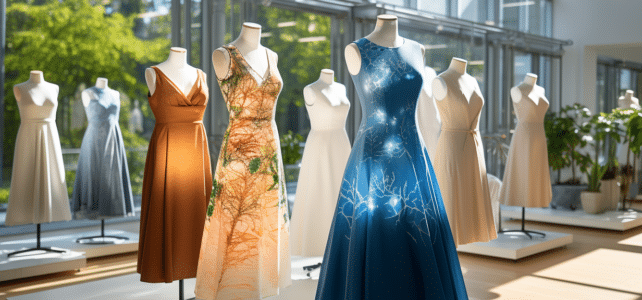
The fashion industry, often criticized for its environmental impact, is undergoing a transformation with the rise of circular fashion. This innovative economic model revolves around waste reduction, material reuse, and extending the lifespan of clothing. By promoting recycling and upcycling, circular fashion promises to transform the textile sector, thereby reducing the ecological footprint while meeting the demands of increasingly environmentally conscious consumers. It paves the way for sustainable practices and could very well represent the future of clothing.
Circular Fashion: Challenges and Perspectives for the Textile Industry
In the relentless turmoil of fast fashion, circular fashion stands as a beacon of hope, guiding the textile industry towards an era of increased responsibility. With the French second-hand fashion market estimated at 14 billion euros by 2030, the circular economy is no longer just a trend, but a revolution in progress. The components of the ‘3Rs’ – Reuse, Repair, Recycle – are key to combating the rising volume of fashion items, offering a tangible response to the ecological imperative.
The principles of circular fashion, which value the life cycle of products, stand in stark contrast to the ephemeral logic of fast fashion. The vision advocated by industry influencers such as Nik Lasson and the initiatives of the Circular Fashion Federation underscore the urgency and possibility of a paradigm shift. The environmental impact of the industry must thus be reassessed in light of these new practices, where every actor, from design to consumption, plays a crucial role.
The call for a sustainable fashion is amplified by voices like Ellen MacArthur, who believes that the fashion loop must be closed. The strategies implemented aim not only to reduce waste but also to rethink the eco-design of clothing. This approach is supported by legislation such as the PACTE law, which encourages companies to adopt a virtuous and responsible economic model.
To realize these challenges, the future of the textile industry is intertwined with innovation. Advances in fashion tech, upcycling, and the use of recycled fibers are all levers activated by avant-garde creators and pioneering brands. Leading figures such as Stella McCartney, with her famous quote ‘The future of fashion is circular. It has to be.’, remind us that the path to truly circular fashion is paved with boldness and commitment.
Strategies and Innovations for Sustainable and Responsible Fashion
Pioneers of the transformation of the fashion industry, creators and brands are injecting a breath of innovation into the sector. Iconic figures such as Jean-Paul Gaultier, with his upcycled haute couture collection, and Prada with its ‘Faux Fur: an upcycling project’, illustrate a fascinating shift. Upcycling, this technique for valuing used clothing, becomes a vector of creativity and environmental impact reduction, pushing the industry towards a regenerative economy.
Follow the rise of Fashion Tech, particularly through events like Fashion Tech Week Paris and BIARRITZ GOOD FASHION, in collaboration with the BALI Chair. These initiatives, true trend incubators, highlight the growing importance of technology in developing more environmentally friendly practices. The study conducted by Accenture and the Circular Fashion Federation, led by Maxime Delavallée, co-founder of Crushon, reveals promising perspectives for the French market, with strategies focused on sustainability.
Legislation supports this virtuous movement. The PACTE law aims to unlock the potential of companies, placing a particular emphasis on Mission-Driven Companies. By encouraging businesses to integrate social and environmental objectives into their purpose, it paves the way for a profound reconsideration of production and consumption practices. Consider raw materials and recycled fibers as cornerstones of this new paradigm, where every design choice carries the seed of the fashion industry of tomorrow.