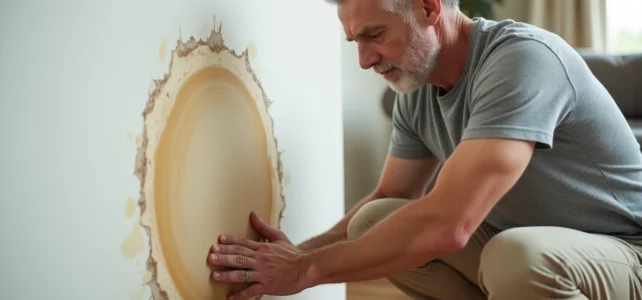
A brown halo appears on a freshly painted interior wall. The usual reflex is to scrape, cover, and ventilate. The problem returns a few weeks later, sometimes in the same spot, sometimes slightly shifted. Identifying the cause of a moisture halo on an interior wall requires going beyond surface observation and methodically tracing back to the actual source of the water.
Recurring halos after work: what visual diagnosis does not show
A wall that has been repaired or repainted poses a particular problem. The new layer of paint or coating masks old marks, and when a halo reappears, it becomes difficult to determine whether it extends an old defect that was poorly treated or if it signals a new problem.
After internal insulation, the path of water vapor in the wall changes. The moisture that used to escape through the surface can become trapped between the insulation and the substrate. The post-work halo often reveals a shift in the dew point within the wall, not a new infiltration from the outside.
A concrete clue: if the stain appears diffusely over a large area, without connection to a high point (roof, window) or a low point (floor, baseboard), interstitial condensation is a serious lead. To better understand the cause of a moisture halo on a wall, it is also necessary to check if the halo concentrates around a joint, a filled crack, or a pipe passage, which rather points to a mechanical origin (leak, infiltration).
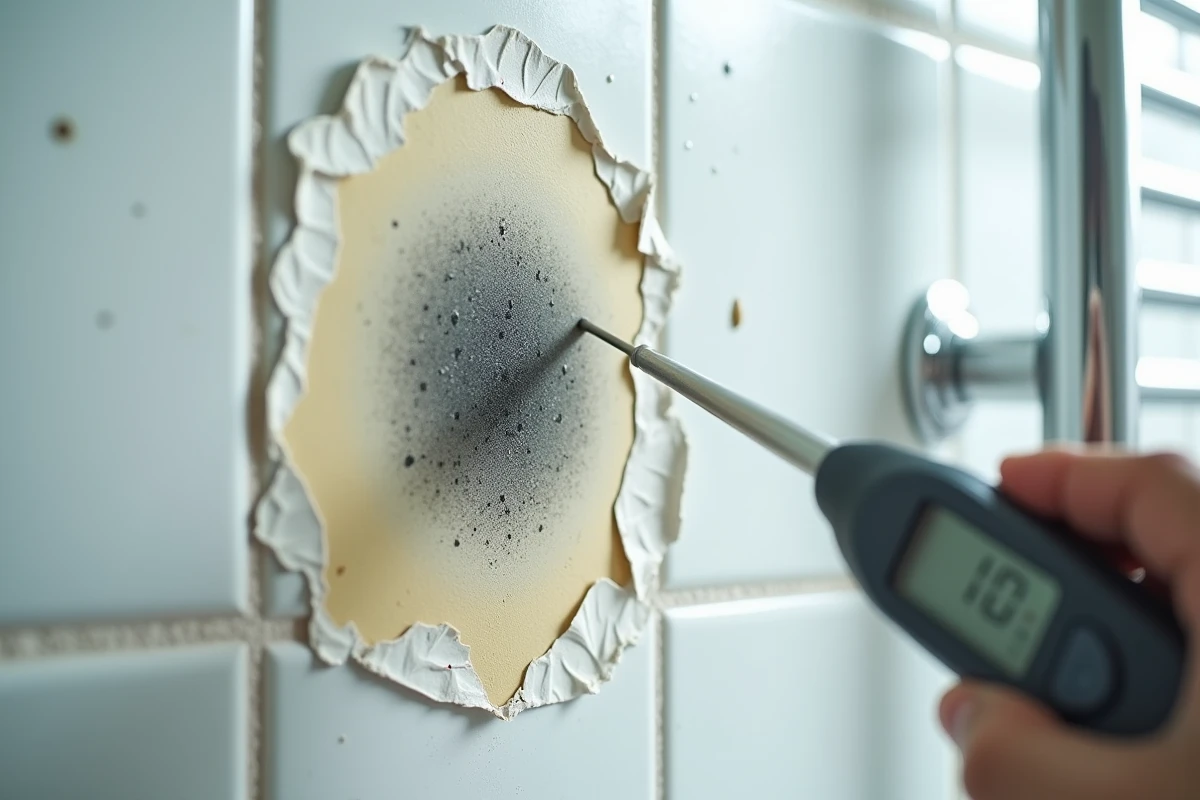
The limits of visual diagnosis are clear in these cases. A glyceryl paint or a waterproof coating can delay the visible appearance by several months, while water is already circulating in the substrate. Field reports diverge on the reliability of a simple visual check when the wall has undergone several layers of finishing.
Timeline of moisture appearance on an interior wall
Before touching the wall, noting when and how the stain evolves provides information that most articles on the subject overlook. The timeline of appearance serves as an effective sorting tool without equipment.
- A halo that appears or expands after heavy rain, then dries in a few days of good weather, points to water infiltration from the outside (facade defect, window joint, crack).
- A stain that forms mainly in winter, during cold and humid weather, unrelated to rainy episodes, indicates a problem of condensation related to a ventilation defect or a thermal bridge.
- A permanent halo, which does not vary with the weather or the season, suggests a continuous source: leak in an embedded network, active capillary rise, or residual moisture trapped in the wall after an old water damage.
- A stain that slowly progresses from the bottom to the top, often accompanied by white efflorescence (saltpeter), is characteristic of capillary rises.
This sorting by timing does not replace a complete diagnosis, but it prevents treating condensation as an infiltration, or vice versa.
Embedded networks and invisible leaks: an underexplored lead
Common content on wall moisture rarely mentions embedded pipes as a source of halos. A slow leak on a water pipe buried in a partition or slab can feed a stain for months without the water meter showing any blatant overconsumption.
A damp wall in immediate proximity to a pipe deserves a pressure test on the concerned network. This test, performed by a plumber, involves pressurizing the circuit after shutting off all outlets. If the pressure drops, the leak is confirmed.
Other methods exist to precisely locate the leak point: acoustic listening, thermal camera, tracer gas detection. These techniques are not reserved for extreme cases. They allow avoiding breaking an entire wall to find a leak on a few centimeters of pipe.
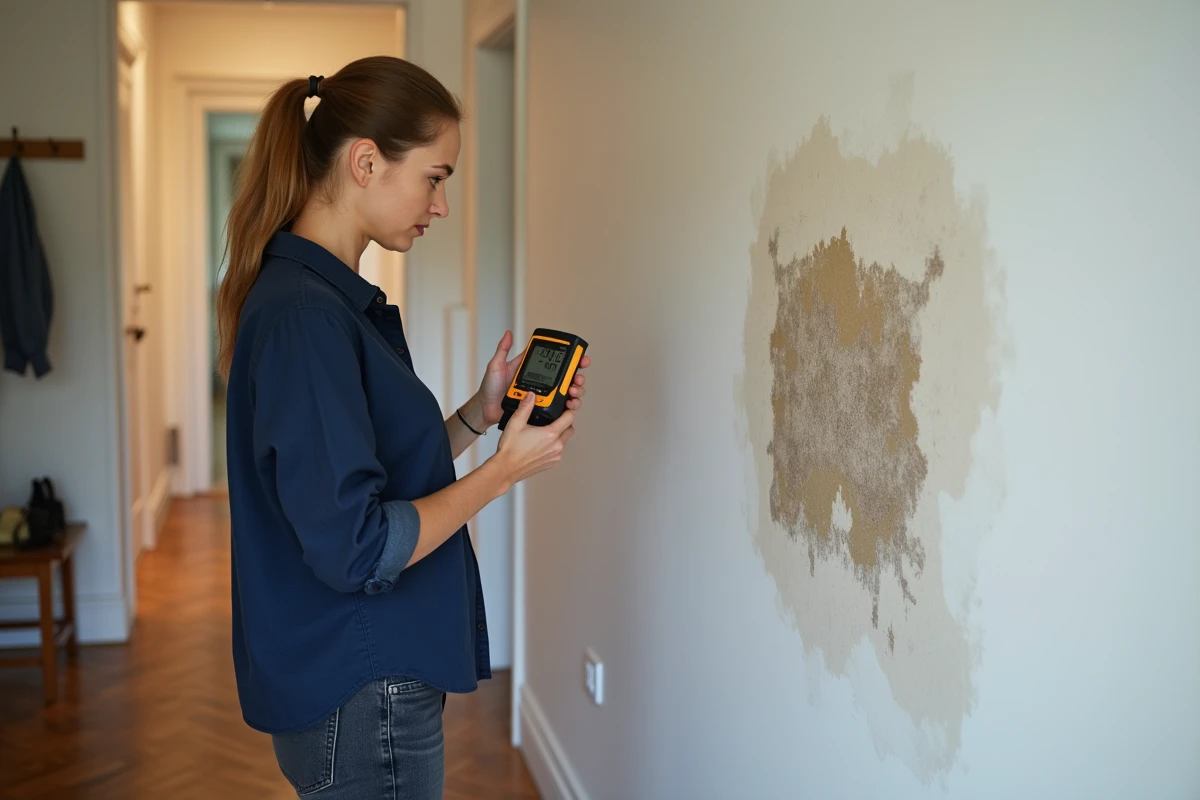
In the absence of a nearby water network, this lead can be quickly ruled out. Its verification should be part of any serious diagnosis, before concluding to condensation or an exterior waterproofing defect.
Condensation, infiltration, or capillary rise: cross-referencing the clues
No isolated sign is sufficient to make a reliable diagnosis. It is the cross-referencing of several observations that allows converging towards the cause.
The location of the stain on the wall provides a first filter. Capillary rises manifest at the lower part, rarely above one meter in height. Infiltrations follow gravity and often appear under a window, along a crack, or at the junction of roof and wall. Condensation, on the other hand, preferentially affects cold areas: room corners, behind a piece of furniture pressed against an exterior wall, window contours.
The floor level of the dwelling also guides the reflection. A ground floor or basement is more exposed to capillary rises. A top floor under the roof accumulates the risks of infiltration through the covering and condensation under the slope.
- Halo at the lower part, presence of saltpeter, wall cold to the touch: probable capillary rise.
- Localized halo, worsened by rain, downward trace: external infiltration to be investigated.
- Diffuse halo, frequent condensation on windows, poorly ventilated room: condensation to be addressed through ventilation.
One point remains tricky: after applying a waterproofing product or an injection treatment, a wall that continues to show halos at the lower part often indicates a capillary treatment that has not reached the necessary depth. Water rises through untreated paths and emerges where the barrier is incomplete.
Identifying the cause of a moisture halo on an interior wall requires combining observation, timeline, and, in ambiguous cases, instrumented measurements. A diagnosis made too quickly leads to unnecessary work. A wall repainted three times over an undetected leak will always end up stained.