
The clarifier and chlorine serve two distinct functions in water treatment: coagulation of suspended microparticles for one, disinfection for the other. Their combination does not pose a problem of direct chemical compatibility, provided that a separate introduction protocol and correct water balance are respected.
Chemical interaction between clarifier and chlorine: what really happens in the pool
A clarifier (cationic polymer, most often based on polyDADMAC or chitosan) acts through coagulation: it neutralizes the negative charges of colloidal particles to aggregate them into filterable clumps. Chlorine, on the other hand, oxidizes organic matter and destroys microorganisms. These two mechanisms do not compete as long as the products are introduced separately into the hydraulic circuit.
The real risk is not molecular incompatibility, but overloading the filtration system. The clarifier generates an increased volume of materials to be captured by the filter media. If the filter is already clogged or undersized, the reformed flocs stagnate in the pool and consume free chlorine through secondary oxidation. We frequently observe this vicious circle in installations equipped with low surface cartridge filters.
When considering using clarifier and chlorine together in the pool, the sequence of addition matters more than simply combining them. Chlorine must have completed its peak oxidation before the clarifier is added, otherwise, part of its disinfecting power will be diverted to degrading the polymer.
pH and free chlorine: the two parameters to lock in before adding a clarifier
An improperly adjusted pH cancels the effectiveness of chlorine much more surely than a clarifier. The active form of chlorine (hypochlorous acid, HOCl) predominates below a pH of 7.4. Beyond 7.8, the proportion of hypochlorite ions (OCl-) increases and the biocidal capacity drops significantly. Adding a clarifier to water with a drifting pH is akin to treating a symptom without correcting the cause of turbidity.
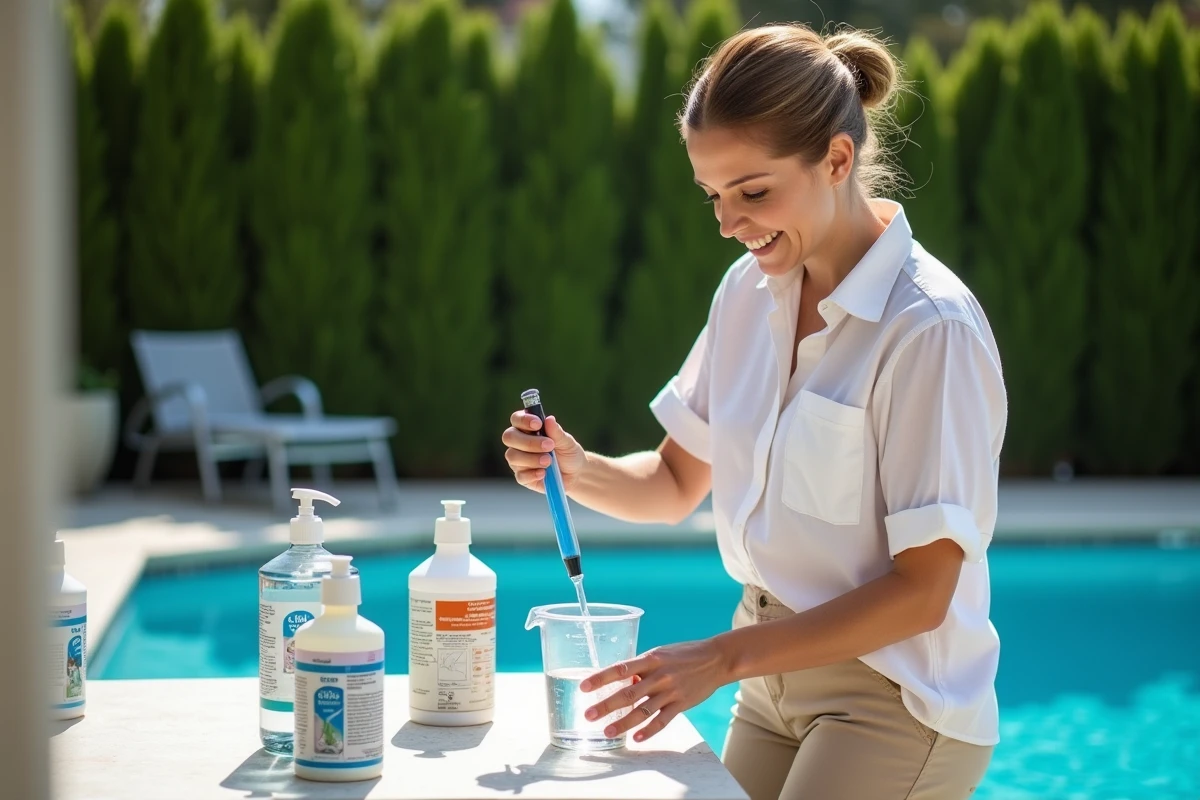
We recommend checking three parameters before any injection of clarifier:
- The pH should be between 7.0 and 7.4 to ensure that free chlorine remains in its most oxidizing form. A prior adjustment with an acid corrector is often necessary after adding new water or during a period of high usage.
- The level of free chlorine should be stabilized at its usual maintenance level. After a shock treatment, one must wait for the residual to drop before introducing the clarifier, as an excess of chlorine prematurely degrades the coagulant polymer.
- Total alkalinity (TAC) should remain within a range that avoids pH rebounds. A TAC that is too low causes fluctuations that compromise both chlorine and clarifier action.
Checking these three values takes a few minutes with a photometer or quality test strips. Skipping this step turns the addition of clarifier into an unnecessary expense.
Filtration and contact time: the factor that instructions underestimate
The majority of commercial instructions indicate pouring the clarifier in front of the return jets or into the skimmer, then letting the filtration run. This instruction masks a crucial technical point: the complete mixing time of the pool volume conditions the result.
A filtration cycle that does not cover the entire volume leaves dead zones where coagulated particles settle at the bottom without passing through the filter. For a medium-sized pool, we recommend keeping the pump running continuously for at least one complete cycle after adding the clarifier, without overnight interruption.
Sand filter or cartridge filter: different protocols
With a sand filter, the flocs are retained in the filter bed and removed during backwashing. The liquid clarifier works well, and a cartridge flocculant placed in the skimmer can even complement the action. A backwash is necessary in the hours that follow to avoid excessive pressure buildup.
With a cartridge filter, the classic flocculant should be avoided: the flocs clog the cartridge very quickly and can damage it. Only a liquid clarifier formulated for this type of filter is suitable. Its finer coagulation granularity produces aggregates that the cartridge captures without immediately clogging, but an early rinsing of the cartridge remains necessary.
Clarifier after a shock treatment with chlorine: sequence and waiting time
The shock treatment raises the level of free chlorine to very high levels to eliminate algae and organic contaminants. Adding a clarifier at this precise stage is counterproductive: the excess chlorine oxidizes part of the coagulant polymer before it has time to act on the suspended particles.
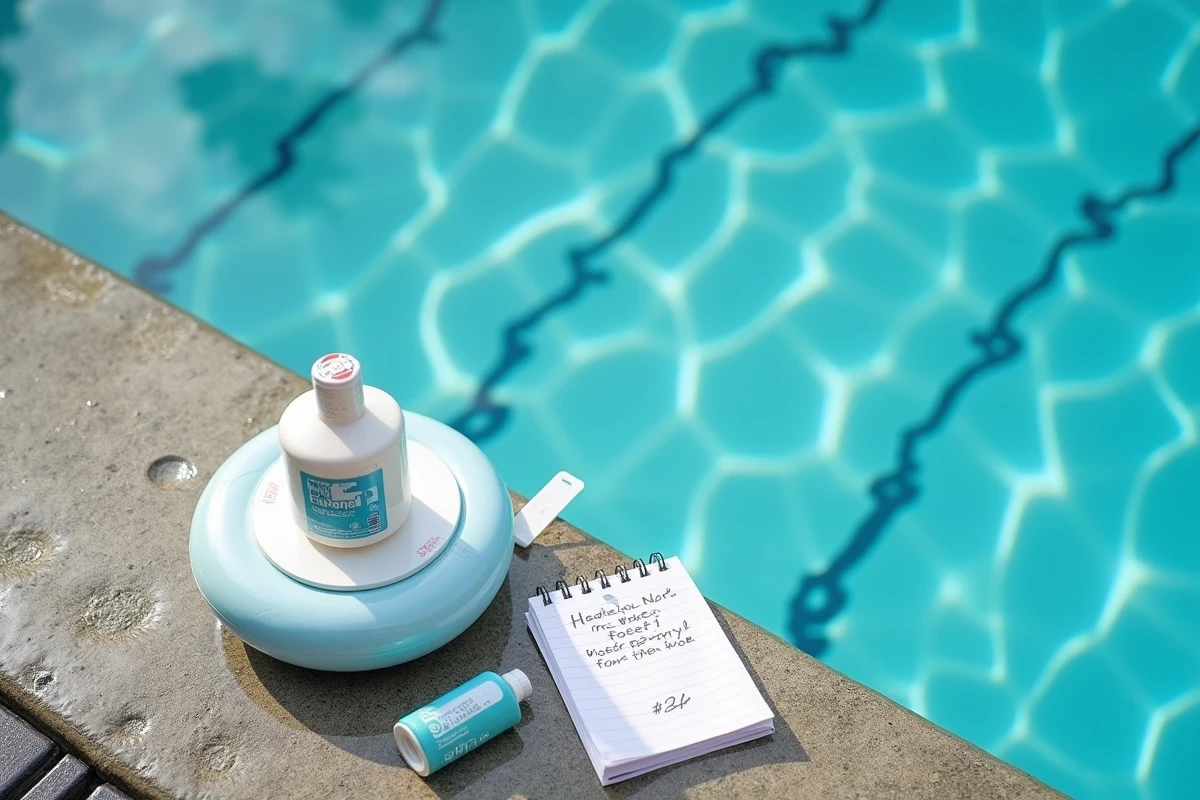
The clarifier is applied in the finishing phase, not during the shock. Specifically, one must wait for the free chlorine to drop back to its maintenance level. This waiting time varies depending on the initial organic load and sunlight, but generally falls between several hours and a full day after the shock.
A common mistake is to pour clarifier and shock chlorine into the skimmer simultaneously. Beyond the loss of effectiveness of the clarifier, this practice concentrates two reactive products at the same entry point of the circuit. Treatment product manufacturers strongly advise against this method due to the risk of localized exothermic reactions in the skimmer.
Practical order for recovering cloudy water
- Adjust the pH between 7.0 and 7.4 and check the TAC.
- Perform the shock chlorine treatment with continuous filtration.
- Wait for the free chlorine to drop to the maintenance level.
- Pour the clarifier in front of the return jets, with filtration running.
- Maintain continuous filtration for a complete cycle, then clean the filter (backwash or cartridge rinse).
Following this sequence allows chlorine to sanitize the water before the clarifier gathers the residual debris to direct it to the filter. Reversing or overlapping these steps prolongs recovery time and increases product consumption.