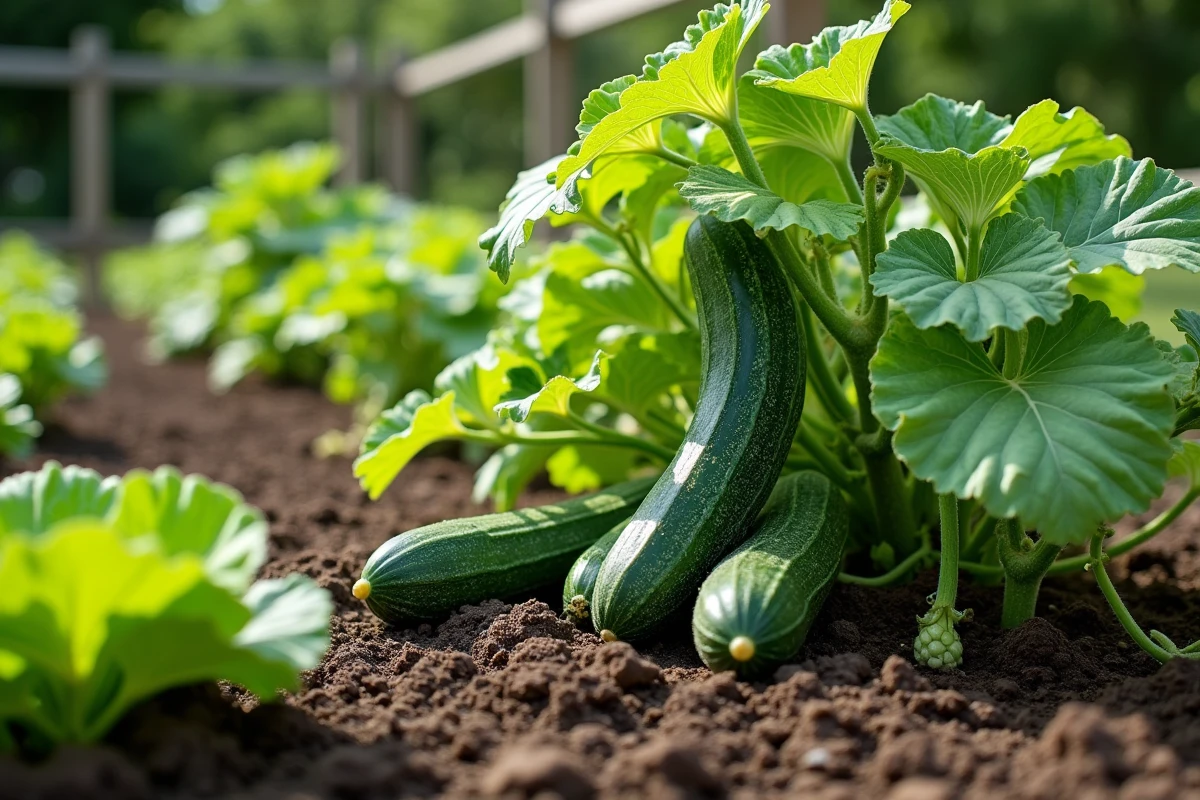
Cucumber and lettuce share similar water and light requirements, making them a logical growing duo in the vegetable garden. Their association is based on concrete mechanisms of root and leaf complementarity, not just a simple tradition of companion planting.
Shading Effect of Cucumber on Lettuce: An Underestimated Mechanism
The wide and sprawling foliage of the cucumber creates a partially shaded area on the ground. For lettuce, which bolts quickly in high heat, this natural shading extends the harvest window by several days in the height of summer.
Trials in micro-farming conducted by the Technical Institute of Organic Agriculture (ITAB) confirm this observation. During the technical day on June 28, 2023, in Thorigné-d’Anjou, the report “Managing Summer Heat in Salad Crops” documented that cucumber foliage reduces leaf burn on lettuce under low cover during heat waves.
Specifically, this means that planting lettuce between rows of trellised cucumbers (on netting or trellis) allows for gradual shading. Early in the season, cucumber plants are still low and let light through. In the height of summer, their cover thickens just when the lettuce needs it most.
A detailed guide on the benefits of cucumber and lettuce in the vegetable garden helps to better understand the mechanisms of this association and its conditions for success.
Soil Water Management: Lettuce as a Living Ground Cover

Cucumber is thirsty. Any technique that limits evaporation around its roots represents a direct gain. Lettuce, with its low and dense foliage, fulfills this function perfectly.
Observations in professional plots show that salads interspersed between cucumber rows keep the soil cooler and reduce the frequency of watering without affecting cucumber yields. The effect is comparable to living mulch, with the added benefit of producing a harvest.
For this mechanism to work, lettuce must be harvested before the cucumber reaches its full production. Lettuce left too long between the rows ends up competing for water. The ideal timing relies on a planting offset:
- Plant lettuce two to three weeks before cucumbers so that they cover the soil from the first irrigations
- Harvest lettuce at the formed head stage, before cucumbers fully cover the space
- Replant a second series of lettuce at the end of summer, when cucumbers begin to decline and release light
This offset avoids competition and transforms the association into a rapid rotation in the same row.
Frisée Lettuce and Cucumber Aphids: The Trap Plant Effect
One of the recurring problems with cucumber in the vegetable garden is the pressure from green aphids, especially in organic cultivation where chemical treatments are not an option. Frisée or red-leafed lettuces play an unexpected role here.
The Chamber of Agriculture of the Pays de la Loire, in its fact sheet “Companion Plants and Trap Plants in Organic Market Gardening,” documents a reduction in aphid pressure on cucumbers when frisée lettuces are associated. These varieties attract certain green aphids more, diverting pressure away from the cucumber.
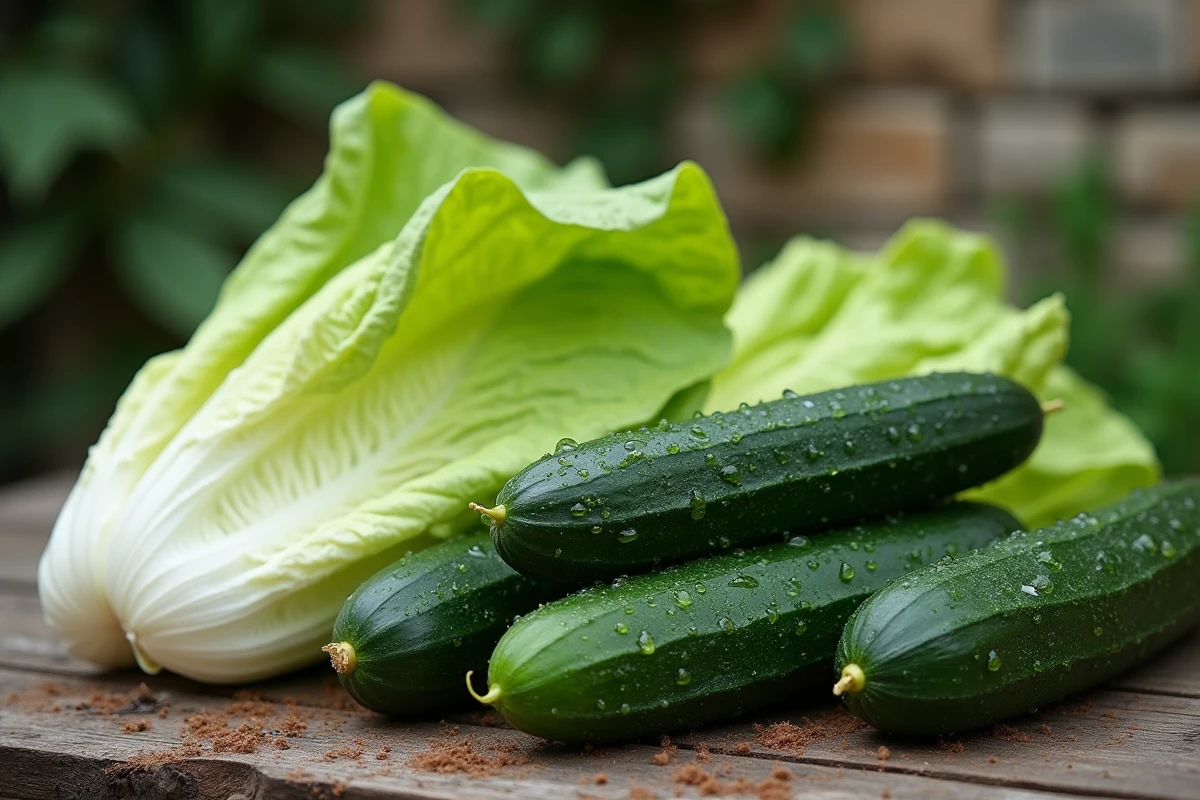
The choice of lettuce variety is therefore as important as the spacing between rows. A smooth-leafed batavia lettuce will not have the same trap effect as a red oak leaf or a lollo rossa. If managing aphids is a priority, favor varieties with cut and colored foliage.
Note: the trap plant effect assumes accepting that the affected lettuces may be partially colonized. They may not be commercially viable or aesthetically pleasing, but they protect the main crop.
Planting Distances and Common Mistakes with the Cucumber-Lettuce Duo
The association often fails due to lack of space. Cucumber is a vigorous plant, with stems that spread over more than a meter if not trellised. Planting lettuce too close to the base will suffocate the plants within weeks.
- For vertically trellised cucumbers (netting, trellis), leave at least thirty centimeters between the cucumber base and the lettuce row
- For sprawling cucumbers (ground cultivation without support), the association becomes very difficult as the foliage quickly covers the entire available surface
- Avoid placing lettuce on the north side of the trellised cucumber, where the shade will be too dense for the head to form properly
Trellising the cucumber is therefore the technical condition that makes this association viable. Without trellising, both crops compete for light and ground space, and lettuce systematically loses to cucumber.
Another common mistake: associating cucumber and lettuce in poorly drained soil. Both plants appreciate moisture, but neither tolerates standing water. Heavy and compact soil promotes the development of downy mildew on lettuce and damping-off on cucumber. A layer of mature compost on the surface and slight hilling of the rows is enough to prevent this risk in most vegetable garden soils.
The cucumber-lettuce duo works when each plant occupies a distinct layer: cucumber high on its support, lettuce at ground level. This shared verticality remains the key to a productive plot in a reduced space.