
Staying at home is not just about installing a grab bar in the bathroom. Solutions that allow for aging well at home form a technical, human, and financial ecosystem where each component conditions the others. Poorly articulated, they lose their effectiveness. Well-coordinated, they can delay the need for institutionalization by several years.
Inclusive housing and CNSA package: a third way between isolated home and nursing home
Since 2023, we have observed a structural shift in the home care offering. Inclusive habitats (senior co-housing, small buildings with shared services, social life coordinators) are no longer marginal experiments. They are recognized and funded by the National Solidarity Fund for Autonomy through the inclusive housing package.
The principle is based on mutualization. A social life coordinator organizes human assistance interventions, collective activities, and risk prevention for a group of residents. Each person retains their private accommodation, lease, and furniture.
This model simultaneously addresses two problems: social isolation, which accelerates cognitive decline, and the unit cost of support, shared among several beneficiaries. Several social landlords and local authorities are now structuring this type of project, with a stabilized regulatory framework.
Professionals in the sector can compare existing systems and identify suitable solutions for each profile at https://www.seniorizon.fr/, which lists support pathways for aging at home.

Teleassistance and connected objects: what really works in daily life
Teleassistance remains the technical foundation of secure home care. The principle has not changed (an alert button, a listening center), but the devices have become more discreet and intelligent. Motion sensors, automatic fall detectors, night light paths: these connected objects complement the classic medallion without requiring voluntary action from the elderly person.
We recommend prioritizing equipment according to three criteria:
- The capacity for passive detection (the device triggers an alert without the intervention of the user, covering loss of consciousness and nighttime falls)
- Interoperability with home care services (transmission of information to the relevant SAAD or SSIAD to adjust the care plan)
- The actual ease of use, tested under conditions of sensory deficits (vision, hearing) and mild cognitive impairments
A sophisticated sensor that an 85-year-old cannot reset after a false alert ends up unplugged in a drawer. Ergonomics take precedence over technology.
Daily allowance for family caregivers: an underutilized financial lever
The AJPA has undergone significant evolution. Since January 1, 2025, it covers up to 264 days over the entire career of a caregiver, spread over a maximum of four relatives (66 days per relative). By January 1, 2026, the daily amount will reach 66.64 euros.
This amount makes it a true temporary replacement income. Employees, self-employed individuals, and compensated job seekers can suspend or reduce their activity during critical periods: post-hospitalization recovery, sudden worsening of dependency, transition to a new support mode.
Why the AJPA changes the equation of home care
Before this revaluation, most family caregivers absorbed the cost of their presence without compensation. The choice between home care and institutional placement was often made under financial pressure, not clinical choice.
The AJPA allows for financing transition periods without disruption of support. A caregiver who has 66 compensated days per relative can cover the two to three months needed to organize a return home after a hip fracture, for example.
Coordination of SAAD, SSIAD, and SAD: the weak point of the system
The home reform initiated by public authorities is gradually merging home assistance services (SAAD), nursing care services (SSIAD), and multi-purpose services (SPASAD) into home autonomy services (SAD). The goal is to create a single point of contact capable of managing assistance with getting up, hygiene care, and medical coordination.
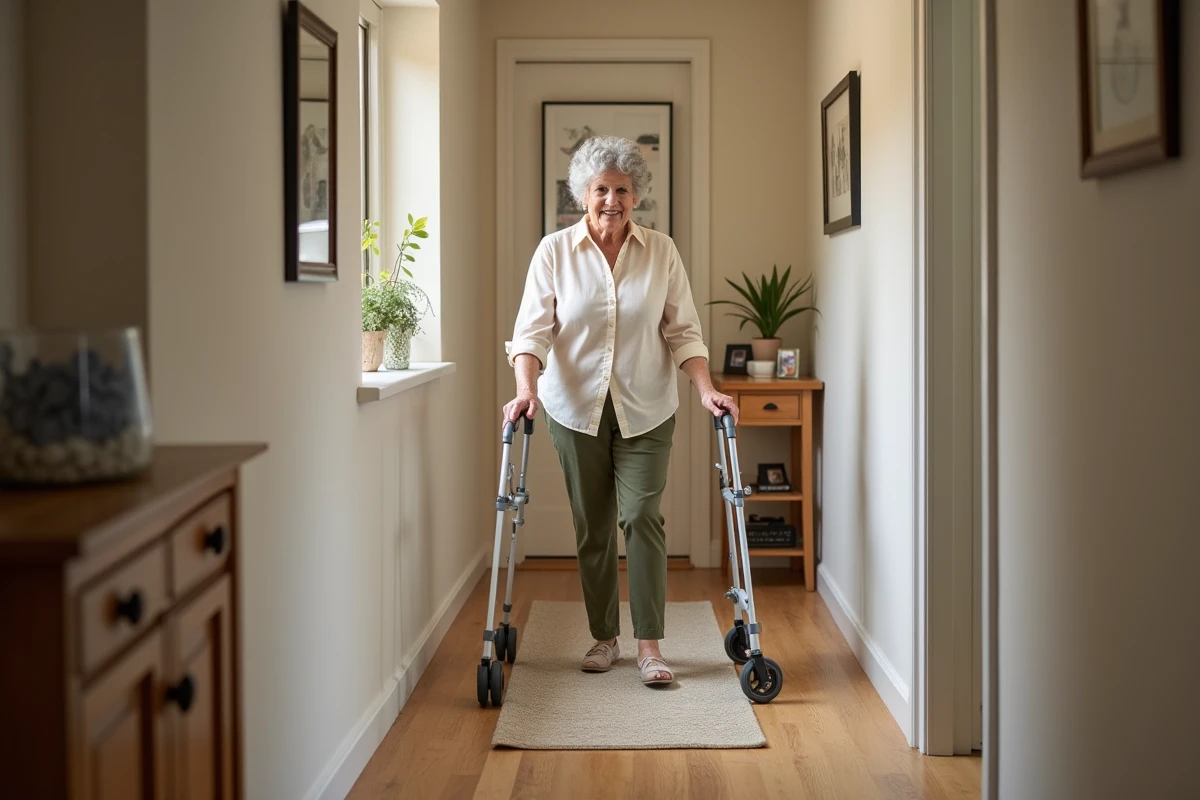
In practice, the coordination between human assistance and care remains the weak link. When the morning caregiver does not relay information about a walking difficulty noticed the day before, the risk of falling persists despite a theoretically complete care plan.
The most effective structures we observe use shared transmission digital tools (dematerialized liaison notebook, secure messaging between caregivers) coupled with an identified pathway referent. Without this pivotal function, the multiplication of caregivers creates confusion rather than security.
Adapting the home is not enough without a coherent care plan
Adapting the home (step-in shower, grab bars, enhanced lighting) has been documented to reduce the risk of falls. The MaPrimeAdapt’ scheme finances part of this work. However, an adapted home occupied by an isolated person, without regular visits from a professional trained to detect warning signals, remains a risky home.
The triptych of adapted housing, coordinated human assistance, and passive teleassistance forms the minimal foundation for sustainable home care. Removing one of the three components weakens the whole, regardless of the level of investment in the other two.