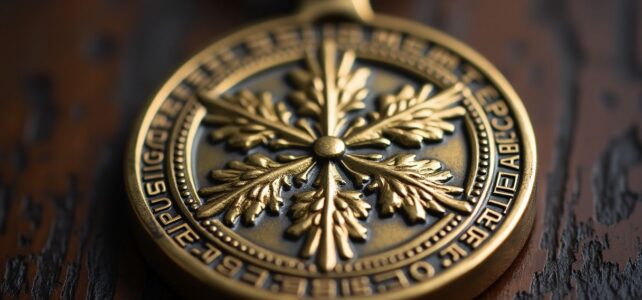
In the vast world of jewelry and art objects, some pieces transcend their mere materiality to become symbols rich in meaning and memory. The precious medal belongs to this category. It is not just an ornamental jewel, but a piece filled with emotion and tradition, finding its place in the most significant moments of human life. Given during baptisms, celebrated in commemorations, or passed down as family heritage, the precious medal evokes memories, promises, and values. It is a bridge between the past and the future, each medal telling a unique story to its bearer.
A historical journey: the medal through the ages
Since time immemorial, humanity has engraved its values and beliefs into metal, and the precious medal is a perfect example of this.
The first medals date back to Antiquity, where they were used for honorific or religious purposes. These pieces were often created in precious metals like gold or silver, symbolizing prestige and power. In medieval Europe, medals evolved, becoming objects of devotion and testimonies of faith. They represented biblical scenes, saints, or significant events, carefully and precisely engraved.
- Renaissance: A period of renewal for the medal, marked by more refined goldsmithing and increased symbolic diversity.
- Modern era: Medals became war souvenirs, honorific distinctions, embodying courage and heroism.
- Contemporary era: Today, the precious medal is often personalized, incorporating personal and unique motifs.
Symbolism and meaning: beyond the metal
The strength of the medal lies in its ability to convey values and messages that are deeply personal and universal.
Each precious medal is imbued with symbolism. For example, a baptism medal is not just a gift; it embodies divine protection and welcome into the religious community. The engraved motifs can tell stories, express wishes for happiness, prosperity, or long life. The choice of metal, shape, and motifs is never trivial; each of these elements contributes to the creation of a unique and meaningful message.
- Religious motifs: Crosses, Virgin Mary, symbols of faith.
- Secular iconography: Animals, stars, floral motifs carrying various meanings.
Craftsmanship and creation: the artisan’s hand
The creation of a precious medal is an art that requires skill, precision, and creativity. Artisans strive to combine tradition and innovation to create unique pieces.
Engraving and casting techniques have evolved over the centuries, integrating modern technologies while respecting traditional methods. The choice of materials is essential; gold, silver, and platinum are metals that bring their own brilliance and durability. The creative process often begins with a sketch, an idea, and then transforms into a tangible work through meticulous attention to detail.
For many families, these medals become a heritage, passed down from generation to generation.
The precious medal: a gift for life
Giving a precious medal is a gesture rich in meaning. It is not just a material gift, but a testament of affection and a bearer of wishes for the recipient’s future.
During baptisms, communions, weddings, or anniversaries, the precious medal stands as the perfect gift. It withstands fleeting trends and retains its emotional value over time. By choosing a medal, one conveys a personal and lasting message that will accompany the bearer throughout their life.
- Baptism and Communion: Symbol of entry into a spiritual community.
- Wedding and Anniversary: Testimony of union and eternal love.
- Personal events: Memory of a unique and precious moment.